



Introduction
Honey is regarded as a blessed food in Islam, and bees have a special place in the Qur’an. The text speaks of healing, while hadith literature describes the Prophet Muhammad (ﷺ) enjoying honey and recommending it in particular accounts.
How is honey described in the Qur’an? Which narrations discuss it, and how is it used in religious and cultural traditions? Let us look at the texts while distinguishing spiritual meaning from medical advice.
Honey in the Qur’an
📖 Surah An-Nahl (The Bees), verses 68-69 - meaning in paraphrase:
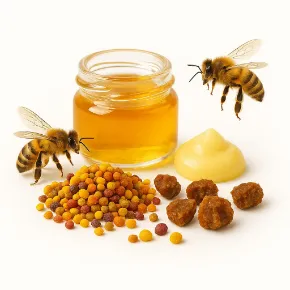
The Lord inspires the bee to make homes in mountains, trees and what people build, then to feed and follow the paths made easy for it. From bees comes a drink of different colours containing healing for people. This is a sign for those who reflect.
🔹 These verses draw attention to the remarkable nature of bees and their following of divine guidance.
🔹 The drink is described as containing healing for people - a statement with an important place in Islamic understanding.
🔹 The verses also mention different colours; honey’s colour and composition vary with its floral sources.
💡 Note: Some Islamic writers discuss these verses as a sign of the Qur’an’s divine origin. This is a theological interpretation; it should not be presented as proof that every honey treats every illness.
Hadith accounts about the Prophet Muhammad (ﷺ) and honey
Hadith literature describes the Prophet (ﷺ) eating honey and recommending it in specific circumstances.
🔹 An account narrated by Abu Sa’id al-Khudri:
A man told the Prophet (ﷺ) that his brother had an abdominal complaint. He was told to give him honey. The man returned, and the instruction to give him honey was repeated. The account describes recovery after repeated use and includes the statement that Allah spoke the truth, while the brother’s abdomen did not. (Sahih al-Bukhari 5684; Sahih Muslim 2217. A religious account, not a treatment plan for all abdominal pain.)
🔹 A report from Aishah (may Allah be pleased with her) states that
the Prophet enjoyed sweet foods and honey. (Sahih al-Bukhari 5431)
🔹 A further report attributed to the Prophet (ﷺ) recommends
honey and the Qur’an as two sources of healing (Sunan Ibn Majah 3452; graded weak by Darussalam).
💡 What can we conclude?
✔ Honey is associated with the Sunnah because the Prophet is reported to have eaten it.
✔ Traditional use of honey appears in hadith literature.
✔ Its place in religious accounts includes food and healing traditions.
Honey in Islamic customs
1. Honey and water in morning routines
☀ Some traditional accounts describe starting the day with honey mixed with water.
✅ This practice is traditionally associated with:
✔ Cleansing, though a detoxification effect is not established.
✔ Digestive comfort, which varies between individuals.
✔ General wellbeing, not proven protection against infection.
2. Honey in ruqyah
📖 In some spiritual practices, honey is mixed with water while chapters such as Al-Fatihah and Al-Baqarah are recited. This describes a religious practice, not a replacement for medical care.
3. Honey at Islamic celebrations
🎉 During Ramadan and Eid al-Fitr, honey is used in traditional sweets.
💡 Note: Some customs describe giving a newborn a drop of honey, but this is unsafe: never give honey to a child under one year because of infant botulism risk, even as a tiny taste.
Conclusion
Honey is seen as a blessed gift from Allah in the Qur’an and hadith traditions. It has a place in food, traditional remedies and spiritual practices.
📢 How do you enjoy honey, and which traditions are meaningful to you? Share your thoughts in the comments! 🐝🍯